
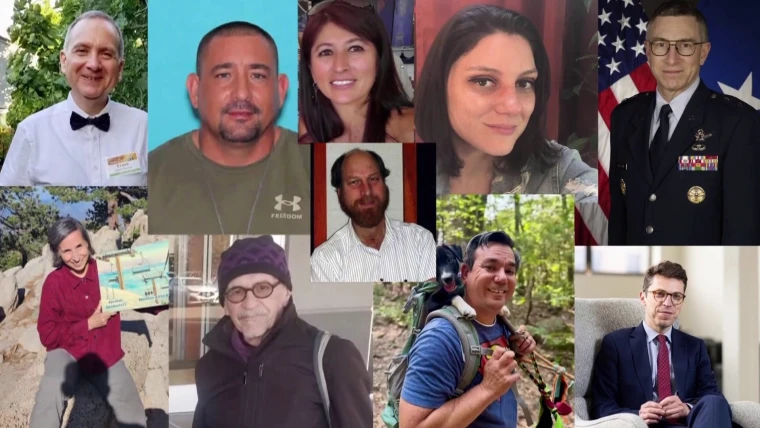
At least a dozen people. All linked to nuclear research, aerospace, or space technology. Most are either dead or missing, and the incidents happened within a relatively short period of time. The “Missing Scientists” case that exploded across American media in April 2026 is undoubtedly one of the strangest chapters in modern scientific history. But it is also a case that has been made much harder to read clearly by the noise of the internet.
The FBI has officially launched an investigation. Congress has asked for briefings from NASA, the Department of Energy, and the Pentagon. And Donald Trump himself has spoken publicly about the cases, saying he hopes they are a “coincidence.” When the president of the United States says “I hope,” concern becomes official.
Let’s look at what we actually know — and what we still do not know.
📌 Contents
The 12 cases — what happened in each one
The common thread: JPL, nuclear fusion, UFOs
The FBI and Congress step in
What the statistics say — and why it matters
Conspiracy theories vs. reality
What to watch in the coming months
Frequently Asked Questions
The 12 cases — what happened in each one
The story begins chronologically with Michael David Hicks, a researcher at NASA’s Jet Propulsion Laboratory (JPL), specializing in comets and asteroids. He died on July 30, 2023, at the age of 59. His cause of death was never made public, and his daughter said publicly that her father had “known medical issues.” No official agency contacted her.
Then came Frank Maiwald, also linked to JPL, who died in Los Angeles in 2024 at the age of 61. In June 2025, Monica Jac Reza — materials processing director at NASA JPL and co-inventor of a metal alloy used in rocket engines — disappeared while hiking in a Los Angeles forest. The Sheriff’s Department has not reported finding a body.
The case that drew the most attention is William Neil McCasland, 68, a retired U.S. Air Force general and former head of the Air Force Research Laboratory at Wright-Patterson Air Force Base — a base long associated with UFO theories. McCasland disappeared from Albuquerque in February 2026, leaving behind his phone, glasses, and smartwatch. The FBI is still searching for him.
Two more names come from Los Alamos National Laboratory, America’s leading nuclear research center: Melissa Casias, 53, and Anthony Chavez, both missing. Casias was last seen walking along a highway in New Mexico in June 2025, with no phone and nothing else with her.
Among the dead is Nuno F.G. Loureiro, 47, a professor at MIT and director of the Plasma Science and Fusion Center, who was murdered in Boston in 2025 by a former classmate — a case that initially seemed straightforward but resurfaced because of his connection to clean-energy research. Also on the list is Carl Grillmair, 67, an astrophysicist who was shot outside his home near Los Angeles in February. The gunman was arrested and does not appear to have known him.
Jason Thomas, 45, former deputy director of chemical biology at Novartis, was found dead in a Massachusetts lake in March 2026, after going missing in December 2025. Police found no signs of foul play. Finally, the list includes David Wilcock, a UFO researcher who died by suicide in April 2026 — although Wilcock did not belong to the same category as the other scientists.
The common thread
If you look at the cases without prejudice, three areas keep appearing: aerospace technology (JPL / USAF), nuclear fusion (MIT Plasma Lab, Los Alamos), and — in the most extreme versions — research tied to “retrieved” technological objects at Wright-Patterson.
That connection to the UFO narrative is what has fueled most of the social media attention.
McCasland, in particular, was reportedly aware of Unidentified Aerial Phenomena programs — and his disappearance came only months after Matthew James Sullivan, a former USAF Intelligence officer, was found dead before he could testify in a federal whistleblower case involving UAP. Congressman Eric Burlison asked the FBI to investigate that death specifically.
In practice, what links most of these cases is not the alleged knowledge of “secrets,” but something more concrete: they all worked, or had worked, on highly sensitive federal programs with clearances involving confidential information.
The FBI and Congress step in
According to CNN reporting from April 2026, the FBI officially took over the investigation into possible links between the cases, working with the Department of Energy, the Pentagon, and local authorities. It is unusual for this level of cross-agency cooperation to be activated in individual cases that are normally handled separately.
The House Oversight Committee, under Republican control, sent letters requesting briefings from the FBI, Department of Energy, Pentagon, and NASA, stating that the situation “raises questions about possible malicious coordination” and constitutes a “national security threat.” NASA, for its part, said there were “no indications of a security threat.”
That contrast between federal scrutiny and institutional calm is exactly what keeps the story alive in public conversation.
💡 Pro tip: To track official developments in this case, the most reliable sources are the House Oversight Committee’s press releases and FBI statements — not social media, where verified facts are often mixed with baseless theories.
What the statistics say
Scientific American published an analysis explaining why the statistical principle of “clustering” — the tendency for seemingly connected events to occur close together in time and geography — may be enough to explain a significant number of the cases.
If you take thousands of scientists working in high-pressure environments, on demanding programs, often with shrinking public funding, the statistical likelihood of losses is not zero.
That does not mean no case deserves scrutiny. It means that the existence of a pattern does not automatically prove malicious intent behind it.
⚠️ Reality check: Several families of the victims have publicly said they see no connection and reject conspiracy theories. Hicks’ daughter was explicit: her father had medical problems, and no one has contacted the family about any “investigation.” Those statements have not received the same attention as the theories.
Conspiracy theories vs. reality
The public-facing version of the “missing scientists” theory, as summarized by Wikipedia, notes that online versions of the story have expanded the list to include people with no real connection to sensitive research, without verifying whether those classifications are accurate. In practice, the “list” grows every time a scientist dies under any circumstances.
What active review of the cases shows is significant inconsistency: Wilcock was not a government scientist, Thomas worked in private pharmaceutical industry without a clearance, and Grillmair appears to have been the victim of random violence. If those cases are removed, the core of a strange cluster of unexplained deaths and disappearances in aerospace and nuclear programs becomes much smaller — though not entirely gone.
🔄 Alternative angle: If you are following this as a national security story rather than a conspiracy story, McCasland is the case worth watching most closely. He is the only one with documented access to UAP-related programs and an unresolved disappearance.
Technoid verdict: this case is a study in how the digital age turns events into a narrative before an investigation is complete. Some of these cases deserve real scrutiny. Others appear to have perfectly ordinary explanations that get lost in the noise. The problem is not the investigation — it is the way it gets mixed with unsupported hype that undermines the credibility of the genuinely troubling cases.
What to watch next
The FBI investigation is still ongoing. As the United States expands its space ambitions — with Artemis II approaching and programs like SpaceX Starship moving at full speed — the aerospace workforce is at a critical point.
Three things are worth watching: first, whether the FBI ever issues an official statement about the alleged “links” or closes the investigation, a decision that would say a great deal. Second, whether McCasland’s disappearance finally gets an answer — this case alone justifies public concern. Third, whether the Oversight Committee receives substantive responses from NASA and DOD, or whether the matter remains trapped in bureaucratic limbo.
For readers also following the Mars mission, it is worth noting that continuing space programs in this climate requires unusual political and institutional stability.
Frequently asked questions
How many scientists have died or disappeared in total?
The most commonly cited list includes 12 people, although the exact composition changes depending on the source. Some analysts argue that the “core” set worth investigating is smaller — around 6 to 7 cases with a direct connection to sensitive government programs. The rest appear to have been added because of loose or indirect ties to science.
Has the FBI confirmed any connection between the cases?
Not officially. The FBI has opened an investigation into possible “links,” but it has not issued a public statement confirming any coordinated pattern. The investigation has been ongoing since April 2026, in cooperation with the Department of Energy, the Pentagon, and local authorities.
Why does the investigation focus on JPL and Los Alamos?
Both institutions involve researchers with security clearances working on sensitive technological and defense-related programs. NASA’s Jet Propulsion Laboratory is a major center for planetary missions, while Los Alamos is the historic core of U.S. nuclear research. The concentration of disappearances in those two spheres is what has drawn attention.
What do we know about General McCasland, and why is his case important?
William Neil McCasland, 68, was the head of the Air Force Research Laboratory at Wright-Patterson Air Force Base — a base long associated with UAP-related research. He disappeared from Albuquerque in February 2026, leaving behind his phone, glasses, and smartwatch. He is the only case on the list with a documented direct link to classified aerospace programs and an unresolved investigation.
How did NASA respond to concerns about its scientists?
NASA issued an official statement saying there were “no indications of a security threat” to its employees. That stands in contrast to the fact that the House Oversight Committee formally requested a briefing from the agency — an institutional mismatch that remains unresolved.
Could this be the work of a foreign adversary?
That is one of the scenarios Congress is considering, although there is currently no public evidence to support it. Foreign intelligence involvement in the death or disappearance of sensitive scientists is historically possible, but it requires concrete proof. In the absence of that, it remains speculation.
Should the average person be worried?
The immediate risk to the average citizen is minimal. These cases involve people with very specific professional profiles. What the public should take away from the story is a more critical attitude toward how social media amplifies — and distorts — cases that require much more careful reading.
What makes the “Missing Scientists” story both serious and easy to misunderstand is precisely this: the overlap of genuinely concerning cases like McCasland with many others that have been placed in the same bucket without sufficient evidence. If the FBI investigation yields anything meaningful, it will come from the first core cases, not the side branches. And when that day comes, it will be facts that matter — not the narrative.