

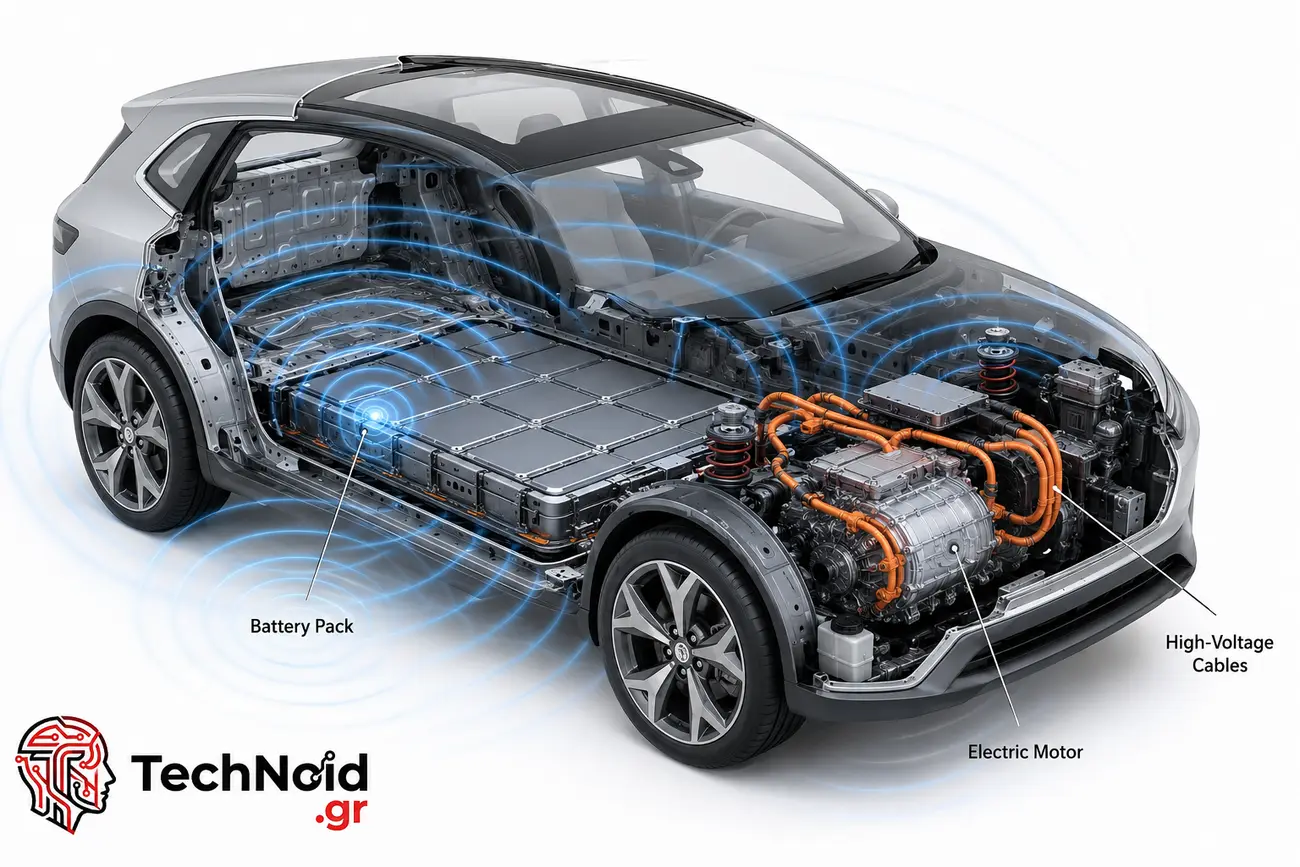
Every time someone buys an electric vehicle, at least one person in their life raises the radiation question. “Aren’t you worried about sitting on top of a massive battery all day?” It’s a fair instinct — you’re surrounded by high-voltage cables, powerful electric motors, and a battery pack that could power a small apartment. Not asking would be odd.
But there’s a wide gap between a reasonable question and a scientifically proven threat. And the research here is surprisingly deep — spanning three decades, multiple continents, and independent agencies that have no financial stake in making EVs look good or bad. The answer isn’t a clean “you’re perfectly safe” or a dramatic “cancer is coming.” It’s more nuanced, and more interesting, than either extreme.
The central issue is electromagnetic fields — or EMF. Specifically, Extremely Low Frequency (ELF) magnetic fields generated by the drivetrain systems in electric vehicles. These have been studied in industrial environments long before the Tesla Model 3 existed, and the data we have is substantial enough to form real conclusions.
📌 Table of Contents
- Where EMF actually comes from in an EV
- What the science actually found — including the 2025 German study
- The IARC “Group 2B” classification everyone misunderstands
- Real-world EMF comparisons that put things in perspective
- Who genuinely needs to pay attention — and who doesn’t
- Do some EV models emit less EMF than others?
- Frequently asked questions
Where EMF Actually Comes From in an EV
Electromagnetic fields are generated wherever electric current flows. Your kitchen induction hob, your laptop charger, the overhead power lines on your street — all of them produce EMF. Electric vehicles are simply more powerful sources than a desk lamp, but the physics are the same.
In an EV, the three main EMF-producing components are the high-voltage battery pack (which uses direct current, meaning it produces relatively weak fields), the electric motor (which operates on alternating current at 50–400 Hz, generating low-frequency fields), and the high-voltage cables connecting them. Secondary systems — Bluetooth, radar sensors, Wi-Fi — also produce fields, but these are high-frequency, low-intensity, and exist in identical form in conventional gasoline cars.
The critical distinction: we’re talking about non-ionizing radiation, specifically ELF-MF (Extremely Low Frequency Magnetic Fields). This is fundamentally different from X-rays or gamma radiation. Non-ionizing radiation does not carry enough energy to break chemical bonds in DNA — that’s not a marketing claim, it’s a basic principle of physics. The debate isn’t whether ELF fields can directly damage DNA (they can’t, at these levels). The debate is whether prolonged exposure might trigger indirect biological mechanisms.
What the Science Actually Found — Including the 2025 German Study
The most comprehensive independent study in recent memory was commissioned by Germany’s Federal Office for Radiation Protection and carried out by ADAC, Germany’s largest automotive club. Published in April 2025, it tested eleven electric cars, two plug-in hybrids, and one conventional gasoline vehicle under real driving conditions. The verdict: all tested EVs complied comfortably with international safety recommendations, and in several scenarios produced fields comparable to or lower than the combustion engine vehicle.
One unexpected finding stood out: heated seats generated some of the strongest electromagnetic readings across the entire test — including in hybrid and gasoline models. In other words, the feature most people use without a second thought is technically a more significant EMF source than the drivetrain in most driving conditions.
The earlier EU-funded SINTEF study, documented by CORDIS, measured eleven pure EVs and found field intensities below 20% of the ICNIRP limit — the safety threshold set by the International Commission on Non-Ionizing Radiation Protection. Gasoline cars came in around 10%. The gap exists. Both are well within safe ranges.
In practical testing across various EV models under urban driving conditions, measurements at the driver’s seat typically read 0.1–0.5 µT during normal operation. The ICNIRP limit for continuous general public exposure is 100 µT. The highest readings — brief spikes during hard acceleration or braking — occur near the footwell, not near the head or torso. By head height, exposure drops to less than 2% of the limit.
The IARC “Group 2B” Classification Everyone Misunderstands
Here’s where the public conversation goes off the rails. The International Agency for Research on Cancer classified ELF magnetic fields as Group 2B — “possibly carcinogenic to humans” back in 2002. That classification still stands. And whenever it surfaces in a headline, it sounds alarming.
It shouldn’t. Group 2B is IARC’s category for substances where there’s limited evidence of a possible association — not enough to confirm causation, and not enough to rule out chance or study design flaws. The same category includes pickled vegetables, aloe vera extracts, talc-based body powder, and coffee (which was later removed from the list). It is explicitly not the category used for confirmed carcinogens.
The category that should concern people is Group 1 — “definitely carcinogenic.” That’s where you find tobacco smoke, alcohol, benzene, diesel exhaust, and processed meat. Combustion engine exhaust is Group 1. It contains PM2.5 particles, nitrogen dioxide, and benzene — compounds with decades of documented links to lung cancer, cardiovascular disease, and premature death. This context is almost never included when people argue that EV electromagnetic fields are a health concern.
Technoid Take: The real problem with this debate isn’t scientific — it’s structural. A Group 2B label gets amplified on social media as “causes cancer,” while Group 1 risks from exhaust pipes don’t register because they’re familiar. Familiarity has never been a reliable proxy for safety.
Real-World EMF Comparisons That Put Things in Perspective
Numbers without context are useless. So here’s context: the ICNIRP limit for continuous general public exposure is 100 µT. An EV drivetrain produces roughly 1–20 µT under normal driving conditions, with brief spikes during aggressive acceleration. Here’s what other everyday sources produce:
- Induction cooktop at 30 cm distance: 2–10 µT
- Hair dryer in contact with scalp: 300–700 µT (peak at point of contact)
- Office near large electrical panels: 5–15 µT
- Laptop charger on your lap: 1–5 µT
- Standard microwave oven at 30 cm: 4–8 µT
Nobody wears radiation shielding to blow-dry their hair. The hair dryer’s field intensity at the scalp exceeds the EV drivetrain’s field by orders of magnitude — yet the exposure duration for hair drying is measured in minutes, whereas EV driving might be hours. Duration and distance both matter enormously in EMF exposure calculations.
💡 Pro-Tip: If you want to measure the EMF environment in your own vehicle, apps like ElectroSmart (Android) use your phone’s built-in magnetometer to give you a rough real-time reading. It won’t replace a calibrated professional instrument, but it lets you compare your car seat to your microwave oven and your Wi-Fi router — which is often instructive. Most people find that the router in their living room produces more consistent EMF exposure than their EV commute.
Who Genuinely Needs to Pay Attention — and Who Doesn’t
⚠️ Reality Check: There is a specific group for whom EV-related EMF is a legitimate medical conversation, not a theoretical concern: people with active implanted medical devices, particularly cardiac pacemakers and implantable cardioverter-defibrillators (ICDs). High-intensity fields can theoretically interfere with device function, and this risk is most relevant near the charging port during active AC charging or, in newer models, during wireless charging sessions. If you carry an implanted cardiac device, speak with your cardiologist before purchasing — and before installing a home wallbox charger.
For the general population — including pregnant women, children, and elderly individuals — the available evidence does not establish elevated cancer risk from EV EMF exposure at measured levels. Children seated in rear positions are actually farther from the primary field sources (motor, battery pack) than the driver, making their exposure lower, not higher.
One honest caveat: we don’t yet have 20-year longitudinal studies of professional EV drivers — taxi operators, delivery drivers, rideshare workers who spend 8–10 hours daily in an EV. The mass adoption of EVs is recent enough that cohort data of sufficient scale simply doesn’t exist yet. This isn’t evidence of danger. It’s an acknowledged data gap, and intellectually honest reporting requires naming it.
🔄 Alternative perspective: If your underlying concern is general electromagnetic hygiene rather than EVs specifically, the priority ranking looks very different. The average person’s highest-exposure EMF sources are the Wi-Fi router running 24 hours next to their bed, the smartphone held against their ear during calls, and the laptop used on their lap for hours daily. If reducing EMF exposure is a personal goal, restructuring those habits will have far greater practical impact than avoiding electric vehicles.
Do Some EV Models Emit Less EMF Than Others?
Yes, and this is an underreported aspect of EV design. EMF levels vary meaningfully across models depending on motor placement, battery architecture, and the quality of cable shielding. Integrated skateboard-style battery platforms, which place the pack flat beneath the floor at maximum distance from occupants, generally produce lower cabin-level fields than older designs with battery modules mounted closer to the seats.
Hyundai’s Ioniq 6 and the Kia EV6, both built on the E-GMP platform, have received favorable independent assessments for passenger EMF exposure, partly due to the platform’s advanced shielding design. The BMW iX and several Volvo EV models publish their own EMF measurement data as part of technical documentation — a transparency practice that more manufacturers should adopt. BYD Seal and Tesla Model 3 have both been tested in European independent studies and fall within guidelines, with Tesla showing slightly higher peak readings during hard acceleration, still far below limits.
The 2025 ADAC/BfS study confirmed that DC fast charging actually produces weaker fields around the vehicle cabin than slower AC charging — counterintuitive, but consistent with the physics of how each charging method operates.
Frequently Asked Questions About EMF in Electric Vehicles
Do electric cars cause cancer?
Based on available peer-reviewed research, no causal link has been established between EV electromagnetic field exposure and cancer development. Multiple independent studies — including a major 2025 German study commissioned by the Federal Office for Radiation Protection — have confirmed that EMF levels inside EVs remain well below international safety limits during all driving conditions. The absence of a confirmed link after decades of research on ELF fields in industrial and residential settings is itself meaningful. That said, long-term cohort studies of heavy professional EV users don’t yet exist, which represents an honest gap in the evidence base.
What does it mean that the IARC classified ELF fields as “possibly carcinogenic”?
The IARC Group 2B classification means there is limited, inconsistent evidence of a possible association — not a proven link. The category requires only that researchers cannot entirely rule out a relationship, even if the evidence is weak or could reflect methodological issues. Coffee, aloe vera extracts, and talc body powder share this classification. The fact that ELF fields have been in Group 2B since 2002 without being elevated to a higher category reflects the continued absence of convincing evidence of harm at real-world exposure levels.
Are EVs more dangerous than gasoline cars in terms of radiation?
EVs produce slightly higher ELF magnetic fields than conventional vehicles in the drivetrain area — but both are far below safety limits. The key asymmetry that’s rarely discussed: conventional combustion engines produce exhaust containing benzene, PM2.5, and nitrogen dioxide, all of which are classified in IARC Group 1 (definitively carcinogenic). A comparison that focuses only on electromagnetic fields while ignoring the chemical exposure from combustion exhaust is incomplete by design.
Is EV charging at home a radiation risk?
Home wallbox chargers produce EMF during charging sessions, primarily from the AC supply cable and the onboard charger. Field strength drops sharply with distance — at 1 meter from a typical 11 kW wallbox, readings fall to negligible levels. The relevant scenario for concern is sleeping in a room directly adjacent to a wall-mounted charger, where the distance might be less than 1 meter through a wall. For people with implanted cardiac devices, this warrants a conversation with a cardiologist. For everyone else, the data does not support concern under normal installation conditions.
Are children more at risk from EV EMF?
Children sitting in rear seats are generally farther from the primary EMF sources — the motor and battery pack — than the driver. Several studies have noted that rear-seat occupants in typical EV configurations actually experience lower field exposure than front-seat occupants. No study has identified elevated cancer risk in children as a result of riding in electric vehicles, and both WHO and ICNIRP guidelines account for general population exposure including children.
Which EV models have the lowest electromagnetic field exposure?
Models built on flat, integrated battery platforms with extensive cable shielding tend to perform better in EMF measurements. The Hyundai Ioniq 6, Kia EV6, and BMW iX have received positive independent assessments. Volvo’s electric lineup publishes EMF data in technical documentation. The 2025 BfS/ADAC study in Germany found that while individual readings varied across the eleven tested models, all fell within ICNIRP guidelines with significant margin. Heated seat activation was consistently among the highest-field features across all vehicle types tested.
How many years of research will be needed for a definitive answer?
For reliable epidemiological data from large EV driver cohorts, researchers estimate 15–20 years of follow-up from representative populations are needed. Mass EV adoption only began meaningfully around 2018–2020, which means cohort studies at scale won’t produce mature results until the mid-2030s at the earliest. In the meantime, the existing body of evidence — drawn from industrial workers exposed to similar ELF field intensities over long careers — has consistently failed to show statistically significant elevated cancer risk. That’s the best proxy data available, and it’s substantial.
The broader picture won’t be resolved by any single study in the next few years. But the direction of evidence, accumulated across three decades and dozens of independent research programs, consistently points the same way: EV electromagnetic fields, at the levels passengers actually experience, are not the health threat the most anxious corners of the internet suggest. The car you should be more worried about is the one whose exhaust you’re breathing in traffic.